

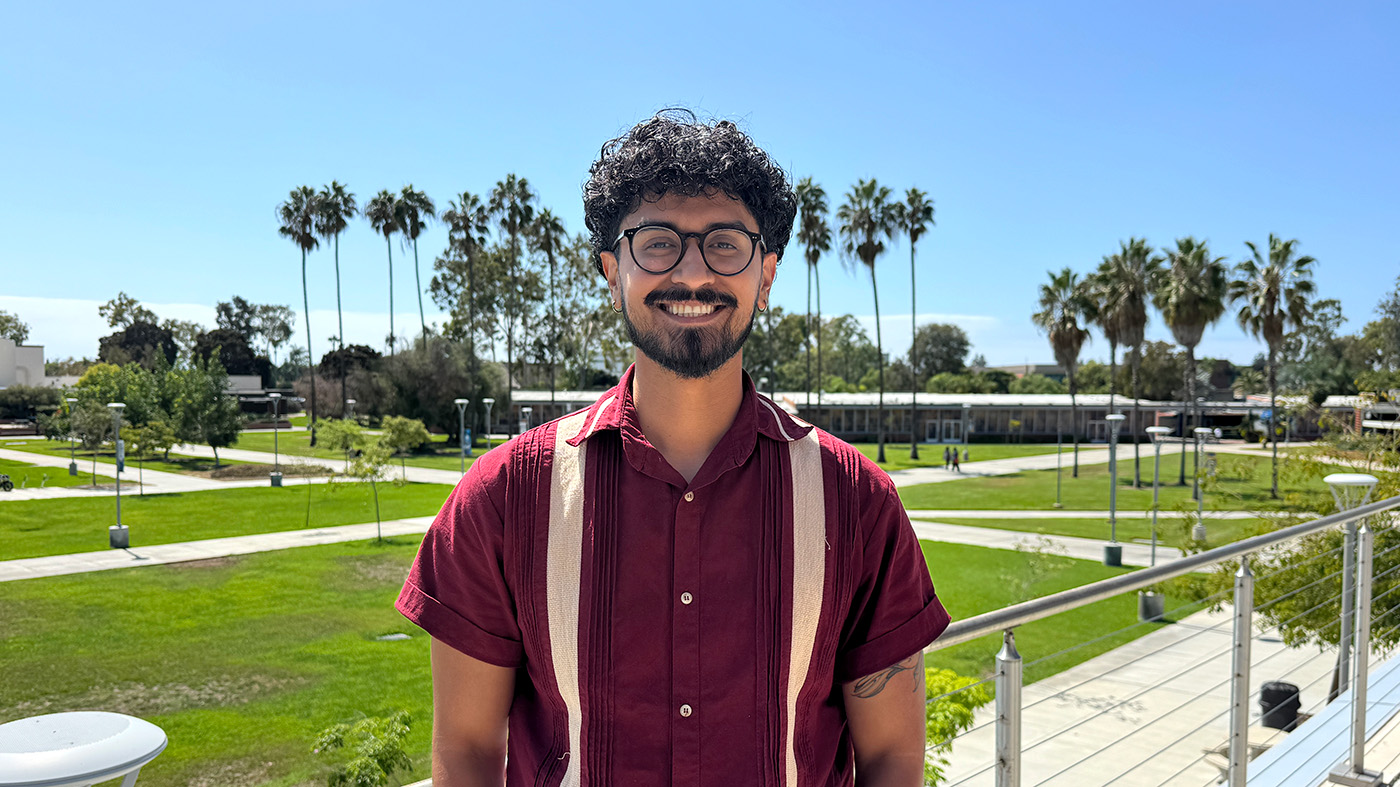
It's Hispanic Heritage Month! Orange Coast College is celebrating the stories, achievements and traditions of our Latine community. First up in the Spotlight Series, meet Eric Palacios.
1. What is your role at Orange Coast College?
I am the Student Leadership Coordinator, supporting students within the Associated Students of Orange Coast College and providing leadership development opportunities for all OCC students.
2. What part of your job do you enjoy most?
I enjoy the opportunity to connect with our students and support their leadership growth through student government, clubs and organizations, and as they look for ways to affect change in their communities. The work is also never stagnant. One day I might be supporting students with advising, conflict resolution strategies or programming, and the next I might be setting up canopies for events like the Pirate Involvement Fair! It keeps me on my toes, and I love that no two days are exactly the same.
3. What does Hispanic Heritage Month mean to you personally?
Hispanic Heritage Month is deeply personal to me and offers a period of reflection on my roots and identity. As the proud child of immigrant parents from Guanajuato, Mexico, I am able to use this time to honor my parents and the sacrifices they made to create a better future for their family.
My parents grew up in poverty, were forced to give up their education, and began working as children before ultimately making the difficult decision to leave their families behind in search of a better future. Their sacrifices have shaped so much of who I am, and Hispanic Heritage Month gives me an opportunity to reflect on where I come from and remind myself that those sacrifices were not in vain.
4. Can you share a bit about your cultural background?
I was born and raised in Anaheim, California, to two loving and hard-working parents from Guanajuato, Mexico. My parents came to this country as teenagers and fully embraced the opportunities they found here. They were able to purchase a home, support their children through higher education, and instill in us the importance of a strong work ethic, community, and tenacity.
That aspect of my heritage is deeply personal to me. As a proud Mexican American, I lean into the collectivist nature of my community. It takes a village to succeed in this country, but it is equally important to be a villager and uplift and support those around you along the way.
5. Are there any traditions, holidays, or cultural practices that are particularly meaningful to you?
Christmas has always been one of my fondest memories and a holiday that I look forward to every year. It is an opportunity to help my mom prep tamales, though my wrapping skills often need work. The season also allows us to visit extended family members and participate in Las Posadas.
There is something special about those traditions because they bring everyone together. The food, music, platicas, and time spent with family remind me that so much of culture is not just about the traditions but about the people we share them with.
6. How has your cultural background shaped the person you are today?
I stand on the shoulders of giants. There is so much that my culture and my family have contributed to who I am today. The values of community, hard work, and tenacity have become values that I try to live by every day.
I understand that many of the opportunities I have today were made possible by the sacrifices of those who came before me. Because of that, I feel a responsibility to continue creating opportunities for those who come after me.
7. What is your ultimate comfort food from your culture, and is there a specific story or person behind why it’s your favorite?
This is probably the hardest question to answer, but I'll have to go with enfrijoladas (think enchiladas but with a blended refried bean sauce). I ate them often when I would visit family in Mexico. My aunt would make them for me, and she recently visited the States, so I was able to have them again after a long time.
One bite and I was transported back to being a six-year-old in my grandmother's house in Irapuato, Mexico. Add some crema, cheese, and a fried egg on the side, and you are in heaven.
8. What is a specific phrase, saying, or proverb in Spanish (or your family’s native language) that you live by or hold dear?
“Échale ganas, mijo.”
This is arguably what got me through both my undergraduate and graduate degrees. My parents never pushed or forced me to pursue the path I chose. However, once I told them I wanted to do something, their support was unwavering.
My parents did not receive a formal education in Mexico, and their understanding of this country's educational system was limited to what they heard in the media and what I was able to share with them. During moments of extreme stress, whether it was papers, comprehensive exams, or group projects, it was those simple words, “Échale ganas, mijo,” that helped me persist.
My parents couldn't always directly understand the stress I was under, but they could sympathize with me. Those words were their way of reminding me that they believed I could do it. Often, it was exactly the motivation I needed.
9. What is one thing you wish people understood or appreciated about Hispanic and Latino cultures?
I wish people understood that Hispanic and Latino cultures are not monolithic. While there are certainly similarities across our communities, the experience of being Mexican, for example, can vary greatly from household to household, just as experiences vary across the many cultures and countries that make up Latin America.
There is so much diversity within our communities. I think it is important to appreciate that diversity rather than trying to define Hispanic and Latino culture as one single experience.
10. When you think about the future of your community, what is one major hope or dream you have for the next generation?
My hope is that we continue to take up space in places where we have been historically excluded. I would love to see increased graduation and retention rates for Latino students, greater representation of Latinos across all sectors of our workforce, and more senior administrators and executives who look like me.
Ultimately, I want the next generation to see people who look like them not only entering these spaces, but also leading them. I want them to know that they belong in the room, that their voices matter, and that they can become the people who open the doors for those who come after them.